
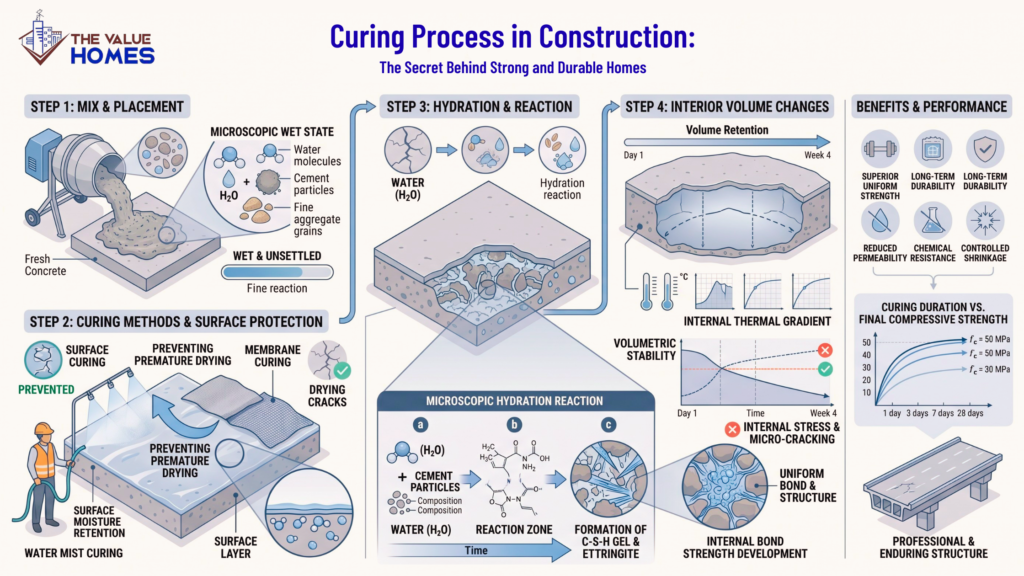
Curing Process in Construction: The Secret Behind Strong and Durable Homes
Introduction When building a house, most people focus on materials like cement, steel, and bricks. However, one crucial step that often gets overlooked is the curing process in construction. It may seem that once the cement has been poured in a structure, the building immediately gains strength. However, the actual strength of a building depends a lot on proper curing. Particularly in places like Chennai, which experience high temperatures, improper curing can cause cracking, loss of strength, and further deterioration of buildings. In this blog, we will discuss the concept of curing and how it is carried out in construction. What is the Curing Process in Construction? Curing means retaining a good amount of moisture content in concrete after pouring the same. Curing helps in the process of hydration in concrete, wherein cement mixes with water. This process is responsible for making the concrete hard and durable. If concrete lacks moisture, then the hydration process will stop early and concrete may become weak. Why is Curing Important? 1. Improves Strength The correct process of curing increases the strength of the concrete material. Otherwise, it will make the building weak and prone to collapse after some years. 2. Prevents Cracks The fast drying process leads to cracking on the surface of the material. These cracks can result in further damages and leaks of water. 3. Enhances Durability The right curing process increases the durability of the concrete material and protects it from environmental conditions. 4. Protects Against Heat Damage During summer, water evaporates easily due to high temperatures. The curing process helps in maintaining moisture levels in the material. Types of Curing Methods 1. Water Curing This is the most used curing technique for construction materials. It involves spraying water onto the surface of the concrete. 2. Ponding Method In this process, barriers are erected on the flat surface such as slabs, and water is continuously stored. 3. Covering Method The concrete slab is covered with wet substances such as gunny bags or cloths. The coverings help in retaining moisture. 4. Membrane Curing A chemical substance is applied to the surface of the concrete to protect against water loss. How Long Should Curing Be Done? Curing time is very important in attaining optimum strength. As a general principle, curing must be carried out for at least 7 consecutive days. Extended periods of curing usually produce stronger concrete. Common Mistakes in Curing ❌ Stopping Too Early Halting the process after a couple of days is among the most common errors. ❌ Inadequate Watering Dampening only with sprinkling is insufficient; the concrete requires deep moisture saturation. ❌ Ignoring Weather Conditions Curing becomes more frequent during hot weather. Omitting this step may compromise the integrity of the construction. ❌ Irregular Curing Continuous curing is necessary. Intermittent curing becomes less effective when done on alternating days. What Happens if Curing is Not Done Properly? The consequences of improper curing include: In conclusion, improper curing negatively impacts the quality of your home. Practical Curing Tips for Better Results Regular and consistent watering is essential throughout the curing period Slabs benefit greatly from the ponding method, which keeps the surface continuously wet To prevent moisture loss, cover the concrete and avoid direct sunlight exposure Keeping an eye on the curing process helps maintain construction quality Skipping curing during the first 7–14 days can seriously affect strength Why Professional Builders Prioritize Curing The most knowledgeable construction firms know that curing is necessary. This will affect the durability, performance, and strength of the whole structure. Construction experts adhere to curing techniques to build homes that last long. Conclusion While curing is a seemingly small part of building, its importance cannot be understated, and it can play an enormous part in how strong and long your building will last. Correctly applying the curing procedure will assure you a house that is strong and durable. However, ignoring this important factor can result in unnecessary costs and problems in the future. Hence, while building your ideal house, pay close attention to curing and not just on materials used. Since your perfect home will not only depend on concrete but also on its curing. Why Choose The Value Homes for Quality Construction? As far as creating a durable and long-lasting house is concerned, each and every stage is important – from construction to finishing. The curing stage during the construction of any property is also very important, and this is where The Value Homes stands out. No matter what the project is – construction, renovation, painting, waterproofing, or costing – our team will offer you complete solutions. In order to build your dream house, The Value Homes is always here for you. Call or WhatsApp us at +91 98840 94443 for expert construction support and a free estimate.